

Scientific Notation With Negative Exponent
Module 48: Integer Exponents and Scientific Notation
By the finish of this section, you will be able to:
- Use the definition of a negative exponent
- Simplify expressions with integer exponents
- Catechumen from decimal annotation to scientific notation
- Convert scientific notation to decimal form
- Multiply and divide using scientific annotation
Use the Definition of a Negative Exponent
We saw that the Quotient Belongings for Exponents introduced earlier in this affiliate, has two forms depending on whether the exponent is larger in the numerator or the denominator.
If  is a real number,
  , and
, and  are whole numbers, so

What if we but decrease exponents regardless of which is larger?
Let's consider  .
.
We subtract the exponent in the denominator from the exponent in the numerator.

Nosotros can also simplify by dividing out common factors:
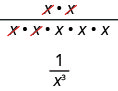
This implies that  and it leads us to the definition of a negative exponent.
The negative exponent tells u.s. we tin can re-write the expression by taking the reciprocal of the base of operations and so irresolute the sign of the exponent.
Any expression that has negative exponents is non considered to be in simplest form. We will apply the definition of a negative exponent and other backdrop of exponents to write the expression with only positive exponents.
For example, if later on simplifying an expression we finish up with the expression  , we will take one more stride and write
  . The answer is considered to be in simplest class when it has simply positive exponents.
Simplify: a)  b)
b)  .
.
Simplify: a)  b)
b)  .
.
Testify answer
a)  b)
b) 
Simplify: a)  b)
b)  .
.
Show respond
a)  b)
b) 
In (Example 1) we raised an integer to a negative exponent. What happens when we raise a fraction to a negative exponent? We'll start by looking at what happens to a fraction whose numerator is one and whose denominator is an integer raised to a negative exponent.
 | |
Use the definition of a negative exponent,  . . |  |
| Simplify the complex fraction. |  |
| Multiply. |  |
This leads to the Property of Negative Exponents.
Simplify: a)  b)
b)  .
.
Simplify: a)  b)
b)  .
.
Show answer
a)  b)
b) 
Simplify: a)  b)
b)  .
.
Show reply
a)  b)
b) 
Suppose at present we have a fraction raised to a negative exponent. Let'due south apply our definition of negative exponents to lead us to a new property.
 | |
| Use the definition of a negative exponent, . |  |
| Simplify the denominator. |  |
| Simplify the complex fraction. |  |
Just we know that is  . . | |
| This tells us that: | 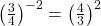 |
To get from the original fraction raised to a negative exponent to the final effect, we took the reciprocal of the base—the fraction—and changed the sign of the exponent.
This leads us to the Quotient to a Negative Power Holding.
Simplify: a)  b)
b)  .
.
Simplify: a)  b)
b)  .
.
Prove answer
a)  b)
b) 
Simplify: a)  b)
b)  .
.
Bear witness respond
a)  b)
b) 
When simplifying an expression with exponents, we must be careful to correctly place the base.
We must be conscientious to follow the Order of Operations. In the side by side example, parts (a) and (b) wait like, but the results are different.
Simplify: a)  b)
b)  .
.
Simplify: a)  b)
b)  .
.
Show respond
a)  b)
b) 
Simplify: a)  b)
b)  .
.
Prove answer
a) 2 b) 
When a variable is raised to a negative exponent, we use the definition the same fashion we did with numbers. Nosotros will presume all variables are non-goose egg.
Simplify: a)  b)
b)  .
.
Simplify: a)  b)
b)  .
.
Show answer
a)  b)
b) 
Simplify: a)  b)
b)  .
.
Evidence answer
a)  b)
b) 
When at that place is a product and an exponent nosotros accept to be careful to use the exponent to the correct quantity. According to the Order of Operations, nosotros simplify expressions in parentheses before applying exponents. Nosotros'll see how this works in the next example.
With negative exponents, the Caliber Dominion needs only ane course  , for . When the exponent in the denominator is larger than the exponent in the numerator, the exponent of the quotient will be negative.
Simplify Expressions with Integer Exponents
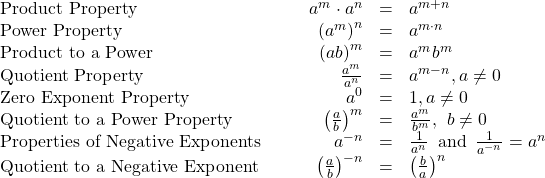
All of the exponent properties we developed earlier in the chapter with whole number exponents use to integer exponents, as well. We recapitulate them here for reference.
If  are real numbers, and are integers, and so
In the next two examples, we'll start by using the Commutative Property to grouping the aforementioned variables together. This makes it easier to identify the similar bases before using the Product Holding.
Simplify:  .
.
Simplify:  .
.
Testify reply

Simplify:  .
.
Show reply

If the monomials have numerical coefficients, we multiply the coefficients, merely like nosotros did earlier.
Simplify:  .
.
Simplify:  .
.
Show answer

Simplify:  .
.
Bear witness respond

In the next two examples, we'll use the Power Holding and the Product to a Power Belongings.
Simplify:  .
.
Simplify:  .
.
Show answer

Simplify:  .
.
Prove answer

Simplify:  .
.
Simplify:  .
.
Evidence answer

Simplify:  .
.
Prove answer

To simplify a fraction, nosotros utilize the Quotient Property and subtract the exponents.
Simplify:  .
.
Simplify:  .
.
Evidence answer

Simplify:  .
.
Show answer

Convert from Decimal Annotation to Scientific Note
Remember working with place value for whole numbers and decimals? Our number organization is based on powers of ten. Nosotros use tens, hundreds, thousands, and then on. Our decimal numbers are too based on powers of tens—tenths, hundredths, thousandths, and so on. Consider the numbers 4,000 and  . We know that 4,000 means
  and 0.004 means
  .
.
If we write the 1000 as a power of x in exponential form, we can rewrite these numbers in this way:
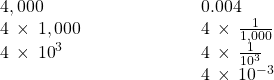
When a number is written every bit a product of two numbers, where the first cistron is a number greater than or equal to one but less than x, and the 2d factor is a power of 10 written in exponential form, it is said to be in scientific notation.
A number is expressed in scientific notation when it is of the form

It is customary in scientific annotation to use as the  multiplication sign, fifty-fifty though nosotros avoid using this sign elsewhere in algebra.
If we look at what happened to the decimal betoken, we can come across a method to easily convert from decimal notation to scientific notation.
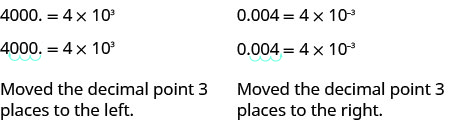
In both cases, the decimal was moved 3 places to become the first factor betwixt ane and 10

How to Catechumen from Decimal Notation to Scientific Note
Write in scientific notation: 37,000.
Write in scientific annotation:  .
.
Prove answer

Write in scientific annotation:  .
.
Show answer

- Move the decimal indicate so that the first factor is greater than or equal to one but less than 10.
- Count the number of decimal places, northward, that the decimal indicate was moved.
- Write the number as a product with a ability of 10.
If the original number is:- greater than 1, the ability of 10 will exist 10 north .
- between 0 and 1, the ability of 10 will be 10 −n .
- Check.
Write in scientific note:  .
.
Write in scientific notation:  .
.
Prove reply

Write in scientific notation:  .
.
Evidence respond

Catechumen Scientific Note to Decimal Form
How can we convert from scientific notation to decimal form? Let's look at two numbers written in scientific note and encounter.

If we look at the location of the decimal point, we can see an easy method to convert a number from scientific notation to decimal form.

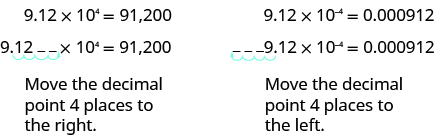
In both cases the decimal point moved iv places. When the exponent was positive, the decimal moved to the right. When the exponent was negative, the decimal point moved to the left.
How to Convert Scientific Notation to Decimal Form
Convert to decimal form:  .
.
Convert to decimal class:  .
.
Catechumen to decimal grade:  .
.
The steps are summarized below.
To catechumen scientific notation to decimal form:
- Decide the exponent,
 , on the factor ten.
 - Move the decimal places, calculation zeros if needed.
- Check.
Catechumen to decimal grade:  .
.
Convert to decimal form:  .
.
Convert to decimal form:  .
.
Multiply and Divide Using Scientific Notation
Astronomers use very large numbers to describe distances in the universe and ages of stars and planets. Chemists use very modest numbers to draw the size of an atom or the charge on an electron. When scientists perform calculations with very large or very pocket-size numbers, they use scientific notation. Scientific notation provides a manner for the calculations to be done without writing a lot of zeros. We will see how the Properties of Exponents are used to multiply and divide numbers in scientific note.
Multiply. Write answers in decimal grade:  .
.
Multiply  . Write answers in decimal class.
Multiply  . Write answers in decimal form.
Split up. Write answers in decimal form:  .
.
Divide  . Write answers in decimal class.
Separate  . Write answers in decimal course.
Access these online resources for boosted instruction and practice with integer exponents and scientific notation:
Key Concepts
Practise exercises
Use the Definition of a Negative Exponent
In the post-obit exercises, simplify.
| one. a) | 2. a) |
| 3. a) | 4. a)  b) b)  |
| 5. a) | 6. a) |
| 7. a) | 8. a) |
| 9. a) | 10. a) |
| eleven. a) | 12. a) |
| 13. a) | 14. a) |
| 15. a) | 16. a) |
| 17. a) | 18. a) |
| nineteen. a) | 20. a) |
| 21. a) | 22. a)  b) b)  |
| 23. a) | 24. a)  b) b)  |
| 25. a) | 26. a) |
| 27. a) | 28. a) |
 b)
b) 
 b)
b)  b)
b) 
 b)
b) 
 b)
b) 
 b)
b) 
 b)
b) 
 b)
b)
 b)
b) 


 b)
b) 
 b)
b) 
 b)
b) 
 b)
b) 
 b)
b) 
 b)
b) 


Convert from Decimal Note to Scientific Note
In the following exercises, write each number in scientific annotation.
| 50. 57,000 | 51. 340,000 |
| 52. 8,750,000 | 53. 1,290,000 |
| 54. 0.026 | 55. 0.041 |
| 56. 0.00000871 | 57. 0.00000103 |
Convert Scientific Annotation to Decimal Grade
In the following exercises, catechumen each number to decimal form.
Multiply and Divide Using Scientific Notation
In the post-obit exercises, multiply. Write your answer in decimal course.
In the post-obit exercises, divide. Write your answer in decimal form.
Everyday Math
| 74. The population of the United States on July 1, 2010 was nearly 34,000,000. Write the number in scientific notation. | 75. The population of the earth on July 1, 2010 was more than 6,850,000,000. Write the number in scientific notation |
| 76. The average width of a human hair is 0.0018 centimetres. Write the number in scientific notation. | 77. The probability of winning the 2010 Megamillions lottery was about 0.0000000057. Write the number in scientific annotation. |
78. In 2010, the number of Facebook users each day who changed their status to 'engaged' was  . Convert this number to decimal form. . Convert this number to decimal form. | 79. At the start of 2012, the United states of america federal upkeep had a deficit of more  . Convert this number to decimal class. . Convert this number to decimal class. |
80. The concentration of carbon dioxide in the atmosphere is  . Convert this number to decimal form. . Convert this number to decimal form. | 81. The width of a proton is  of the width of an atom. Convert this number to decimal grade. of the width of an atom. Convert this number to decimal grade. |
| 82. Health care costs The Centers for Medicare and Medicaid projects that American consumers volition spend more than $iv trillion on health care past 2017
| 83. Coin production In 1942, the U.S. Mint produced 154,500,000 nickels. Write 154,500,000 in scientific annotation. |
| 84. Distance The altitude betwixt Earth and i of the brightest stars in the nighttime star is 33.7 light years. One light year is about six,000,000,000,000 (half dozen trillion), miles. a) Write the number of miles in 1 low-cal year in scientific notation. b)Use scientific notation to detect the altitude between Earth and the star in miles. Write the answer in scientific notation. | 85. Debt At the end of fiscal yr 2019 the gross Canadian federal government debt was estimated to exist approximately $685,450,000,000 ($685.45 billion), according to the Federal Budget. The population of Canada was approximately 37,590,000 people at the end of financial twelvemonth 2019 a) Write the debt in scientific notation. b) Write the population in scientific annotation. c) Observe the amount of debt per person by using scientific notation to divide the debt past the population. Write the respond in scientific notation. |
Writing Exercises.
| 86. a) Explain the meaning of the exponent in the expression b) Explain the significant of the exponent in the expression | 87. When you convert a number from decimal notation to scientific notation, how practice y'all know if the exponent will be positive or negative? |
 .
.Answers
1. a)  b) b)  | 3. a)  b) b) | 5. a)  b) 25 b) 25 |
vii. a)  b) 10000 b) 10000 | 9. a)  b) b)  | 11. a)  b) b)  |
13. a)  b) b)  c) 49 d) c) 49 d)  | 15. a)  b) b)  c) d) c) d) | 17. a)  b) b)  |
19. a)  b) b)  | 21. a) b) b)  | 23. a)  b) b)  |
25. a)  b) b)  c) c) | 27. a) b) b)  c) c)  | 29. a)  b) b)  c) c) |
31. a) 1 b)  c) c)  | 33.  | 35.  |
37.  | 39.  | 41.  |
43.  | 45.  | 47.  |
49.  | 51.  | 53.  |
55.  | 57.  | 59. 830 |
| 61. 16,000,000,000 | 63. 0.038 | 65. 0.0000193 |
| 67. 0.02 | 69.  | 71. 500,000,000 |
| 73. 20,000,000 | 75.  . . | 77.  |
| 79. 15,000,000,000,000 | 81. 0.00001 | 83.  |
85. a)  b) b)  c) c)  | 87. Answers will vary |
Attributions
This chapter has been adjusted from "Integer Exponents and Scientific Notation" in Uncomplicated Algebra (OpenStax) by Lynn Marecek and MaryAnne Anthony-Smith, which is under a CC By 4.0 Licence. Adapted past Izabela Mazur. See the Copyright page for more information.

Scientific Notation With Negative Exponent,
Source: https://spscc.pressbooks.pub/techmath/chapter/integer-exponents-and-scientific-notation/
Posted by: merrittwenctim.blogspot.com
0 Response to "Scientific Notation With Negative Exponent"
Post a Comment